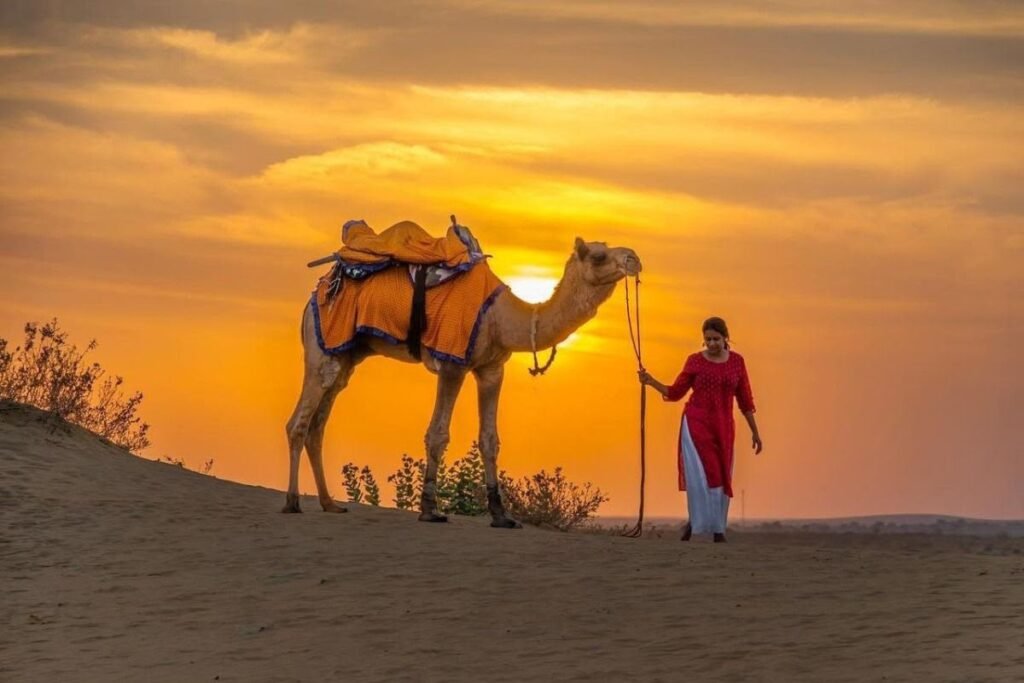
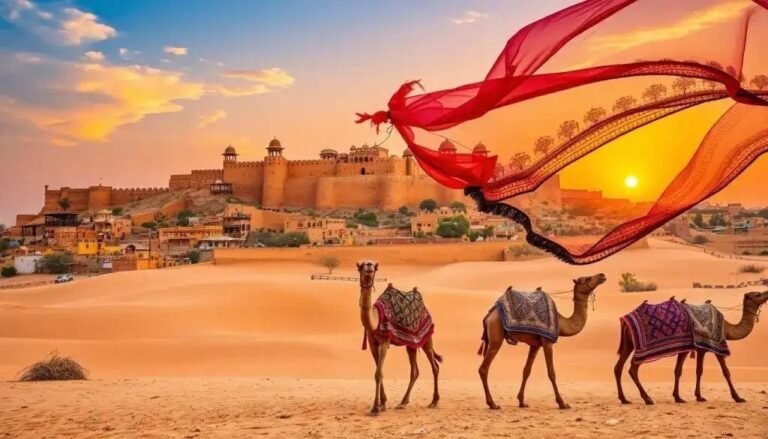
The Thar, or Great Indian Desert, covers a huge area of western Rajasthan and stretches into Pakistan. Most of it is rocky scrubland dotted with villages, thorn trees and grazing camels, but around Jaisalmer the land rises into rolling dunes of fine golden sand. These dunes, especially at Sam and Khuri, are where most visitors experience the desert, usually on an overnight trip from Jaisalmer.
Sam and Khuri
- Sam Sand Dunes: about 40 km west of Jaisalmer, on the edge of the Desert National Park. These are the biggest and most dramatic dunes near the city, with high ridges of sand. They’re also the busiest, especially at sunset, with camel rides, jeep “dune bashing”, stalls and a long strip of camps.
- Khuri: about 45 km south-west of Jaisalmer, around a traditional village of mud-walled, thatched houses. The dunes are smaller but far quieter, with a more peaceful, rural feel.
Further out, some camps are set among remote dunes away from both, for a truly quiet night under the stars.
What it’s like to visit
Most trips leave Jaisalmer in the afternoon. You drive west through the desert, often stopping at a village, then ride a camel or a jeep up onto the dunes to watch the sun set over the sand. After dark, the camps light fires, serve a Rajasthani dinner and host folk musicians and dancers. The night sky, far from city lights, is spectacular. Morning brings a cool sunrise over the dunes before you return to the city.
Kuldhara, the abandoned village
On the road to Sam, Kuldhara is a village of roofless stone houses, deserted in the early 19th century. Legend says its Paliwal Brahmin families left overnight to escape a cruel minister, cursing the village so that no one could live there again. Today it’s a protected heritage site with a small entry fee, eerie and photogenic in the late-afternoon light.
Plan your visit
Combine a morning at Jaisalmer Fort and Patwon ki Haveli with an afternoon drive to Kuldhara and the dunes. See our camel safari and desert camp page and our Rajasthan travel guide.