Swayambhunath crowns a small hill on the western edge of Kathmandu, visible from much of the city. Its name means “self-arisen”: according to legend, the Kathmandu Valley was once a lake, and a lotus that grew in its centre gave off a miraculous light, on the spot where the stupa now stands. The site is believed to be more than 2,000 years old, and it’s one of the most sacred Buddhist places in Nepal, revered by Hindus too. It’s part of the Kathmandu Valley UNESCO World Heritage Site.
What to see
The great white dome of the stupa is topped by a gilded tower (harmika) painted on all four sides with the eyes of the Buddha, gazing out over the valley, with a curling symbol between them representing unity. Around the base, pilgrims walk clockwise, spinning rows of prayer wheels, while strings of colourful prayer flags flutter overhead. The platform is crowded with smaller shrines, chaityas (miniature stupas), statues, a Tibetan monastery and the Hindu temple of Harati, the goddess who protects children.
Hundreds of rhesus monkeys live on the hill, which is why visitors call it the Monkey Temple. They’re considered holy, but they’re also bold, so keep food and loose items out of sight.
What it’s like to visit
The most atmospheric approach is the steep eastern stairway of about 365 steps, flanked by stone statues and monkeys; a road also reaches a car park near the top on the western side. At the top, views stretch across Kathmandu to the hills and, on clear days, the Himalaya. Early morning, when Buddhist and Hindu pilgrims come to circle the stupa and chant, is magical, and sunset is beautiful too. Allow 1–1.5 hours.
Plan your visit
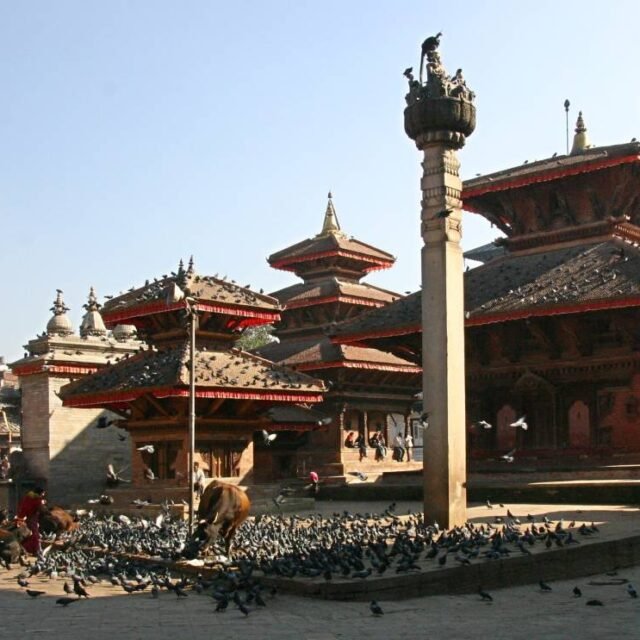
Combine Swayambhunath with Kathmandu Durbar Square, about 15 minutes away, and later Boudhanath and Pashupatinath. See our 9-day Nepal tour.