Welcome back, ! Continue planning: Not you?
New Book Your Taj Mahal Tickets
Jantar Mantar
Monument · Jaipur

Jantar Mantar

Jai Singh II's 18th-century stone observatory in Jaipur, with the world's largest stone sundial. A UNESCO site next to City Palace. Timings, 2026 tickets and how it works.

  • 09:00 – 16:30
  • Tickets from ₹100
  • 1 hour
Plan your visit

Visiting Jantar Mantar

Opening hours

Opens9:00 amCloses4:30 pm

09:00 – 16:30

09:00–16:30 every day; evening light and sound show (separate ticket)

  • Time needed1 hour
  • Closed onOpen every day
  • Best seasonNov – Feb

Best time to visit

  1. January: Best time
  2. February: Best time
  3. March: Good
  4. April: Avoid if you can
  5. May: Avoid if you can
  6. June: Avoid if you can
  7. July: Possible
  8. August: Possible
  9. September: Possible
  10. October: Best time
  11. November: Best time
  12. December: Best time
  • Best timeWinterNov – Feb

    8–24°C

    Clear sun for the sundials

  • GoodSpringMar

    15–33°C

  • Avoid if you canSummerApr – Jun

    Up to 44°C

    No shade; go at opening

  • PossibleMonsoonJul – Sep

    25–34°C, humid

    Clouds can hide the sundial shadows

  • Best timeAutumnOct

    18–33°C

Good to know

Best seasonOctober to March
Best monthsNovember to February
Best time9:00–11:00 am, in sunshine but before the heat
Alternative timemid-afternoon on a clear day
Best photographythe Samrat Yantra and the Jai Prakash bowls in low sun
Recommended visit duration1 hour
Avoidmidday in summer (no shade); cloudy days (no shadows)

Address

Gangori Bazaar, J.D.A. Market, Pink City, Jaipur, Rajasthan 302002 (next to the City Palace) Directions

Entry tickets

Entry ticket prices
Foreign tourists – adultsRate from 1 January 2026₹600
Indian citizens – adultsRate from 1 January 2026₹100
Rajasthan composite pass (10 days) – adultsForeign visitors; ₹1,300 for Indians; all state monuments and museums₹5,500

Prices are set by the authorities and can change.

The story

About Jantar Mantar

An observatory of stone

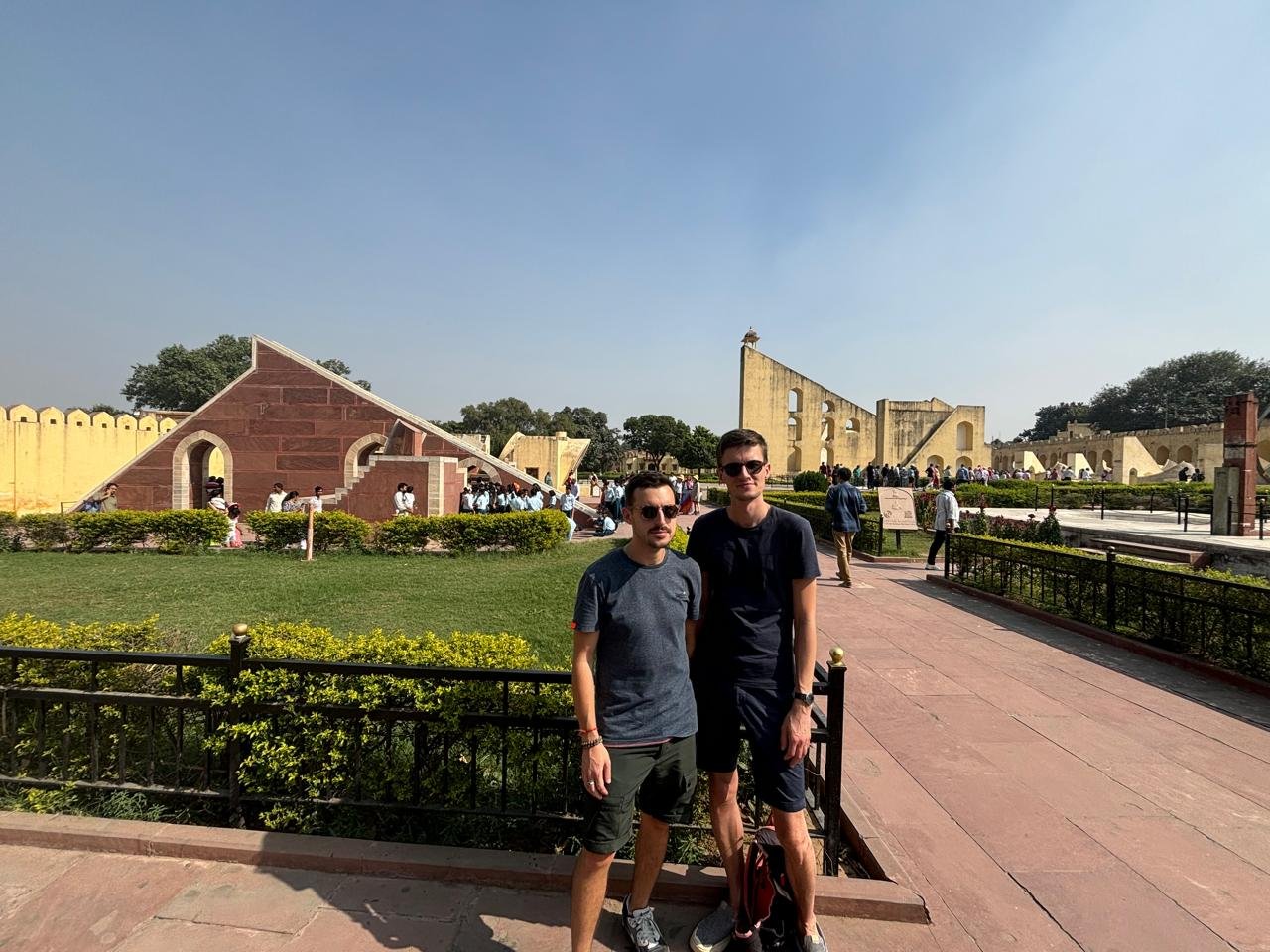
Jantar Mantar sits beside the City Palace in the heart of Jaipur’s old city, a courtyard filled with strange, beautiful geometric structures: ramps, arcs, bowls and staircases that seem to lead nowhere. Each is an astronomical instrument, built at a giant scale so it could measure time and the positions of the sun, moon, planets and stars with the naked eye. Maharaja Sawai Jai Singh II, a keen astronomer and mathematician, built it between about 1728 and 1734. It’s the largest and best preserved of the five observatories he built in north India, and a UNESCO World Heritage Site since 2010.

History

Jai Singh II, who founded Jaipur, studied Hindu, Islamic and European astronomy and found that the brass instruments of his time were too small to be accurate. His answer was to build them in stone and masonry, so large that their scales could be read to fractions of a degree. He built observatories in Delhi, Jaipur, Ujjain, Varanasi and Mathura; the one at Mathura has disappeared. The Jaipur instruments were restored in the early 20th century and some are still used to forecast the monsoon and calculate festival dates.

What it’s like to visit

The site has 19 main instruments. With a guide, the highlights are:

  • Samrat Yantra: the “supreme instrument”, a giant sundial with a triangular wall about 27 m high. Its shadow moves across the curved scales at about 6 cm a minute, telling local time to within about two seconds. It’s the largest stone sundial in the world.
  • Laghu Samrat Yantra: a smaller sundial, accurate to about 20 seconds, where it’s easier to watch the shadow move.
  • Jai Prakash Yantra: two sunken hemispheres marked with a map of the sky, used to find the positions of the sun and stars.
  • Ram Yantra: two cylindrical structures for measuring the height and direction of celestial objects.
  • Rashivalaya Yantras: twelve instruments, one for each sign of the zodiac, each angled to that sign’s position.

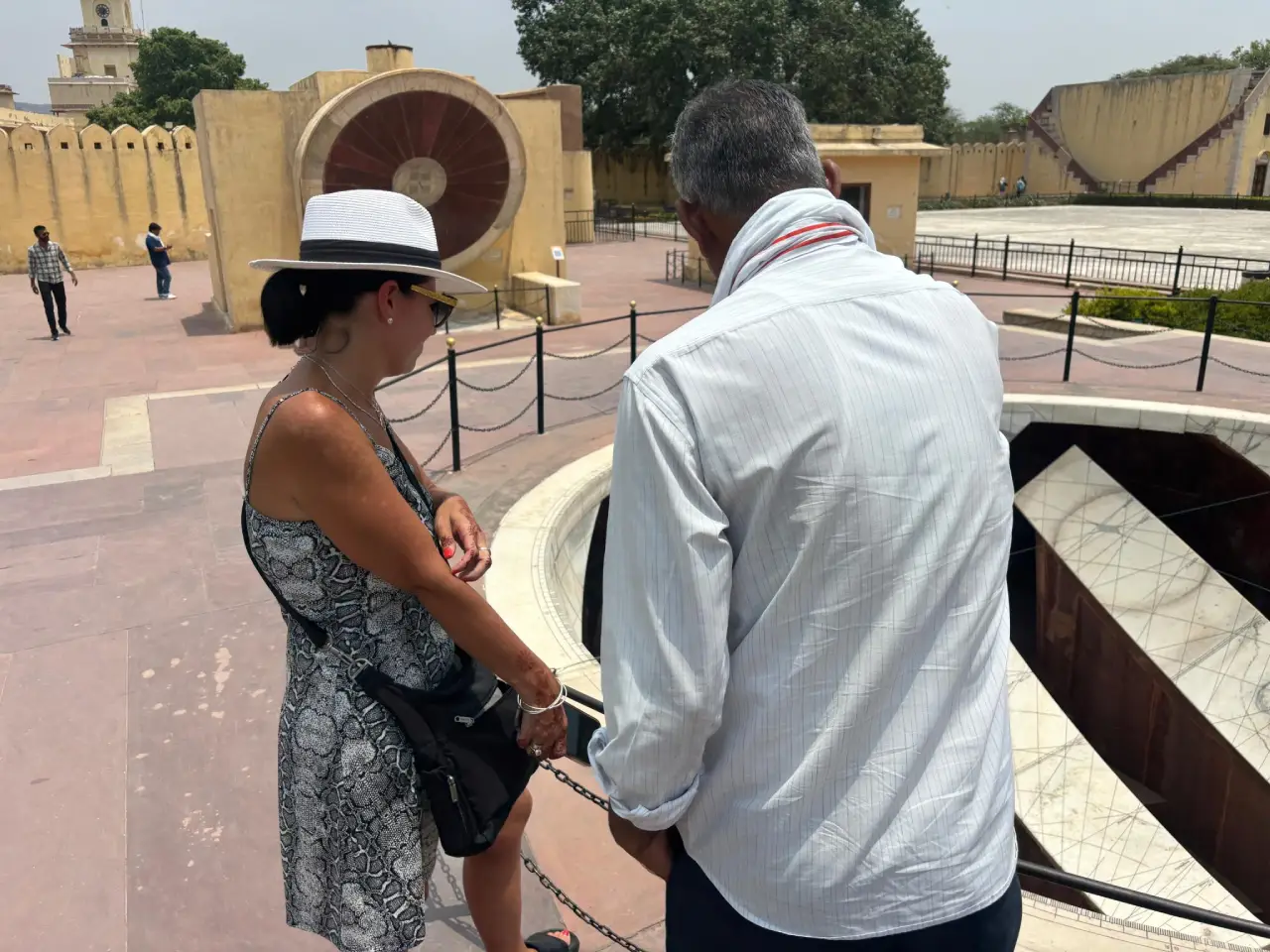
Allow about an hour. There’s little shade, so mornings are best. Without a guide or audio guide, the instruments are hard to understand, so it’s well worth having one.

Plan your visit

Jantar Mantar is right next to the City Palace and a 10-minute walk from Hawa Mahal, so the three make a natural half day in the old city, often after Amber Fort in the morning. Read our Rajasthan travel guide for more.
Highlights

Don’t miss

  1. 01

    Samrat Yantra

    The world's largest stone sundial

  2. 02

    Laghu Samrat Yantra

    Watch the shadow move minute by minute

  3. 03

    Jai Prakash Yantra

    Sunken hemispheres mapping the sky

  4. 04

    Rashivalaya Yantras

    Twelve instruments, one for each zodiac sign

  5. 05

    Ram Yantra

    Cylinders for measuring the stars' height

Good to know

Know before you go

  • Open every day
  • Little shade; bring a hat and water
  • A guide or audio guide makes the instruments understandable
  • Don't climb on the instruments
  • Ticket prices rose on 1 January 2026

Things to do in Jantar Mantar

1

Watch the time on a sundial

Check your watch against the shadow on the Laghu Samrat Yantra.

2

Stand beneath the Samrat Yantra

Look up at the 27 m wall of the largest stone sundial in the world.

3

Find your zodiac sign

Each of the twelve Rashivalaya instruments is set for one sign.

4

Learn with a guide

A guide explains how each instrument measured the sky.

5

Combine with City Palace

The palace is right next door, and Hawa Mahal is a short walk.

When to visit

Come on a sunny morning between October and March: the sundials need sunshine, and there's little shade. It's open every day from 9 am.

Getting there & around

Jantar Mantar is in the walled old city, next to the City Palace entrance and about 10 minutes' walk from Hawa Mahal. It's about 15 minutes by car from Jaipur railway station. The nearest metro station is Badi Chaupar (Pink Line), about 10 minutes' walk.

Where to stay

Heritage havelis in the old city are within walking distance. C-Scheme and Civil Lines, 10–15 minutes away, have most of the city's larger hotels.

Food & where to eat

There's no café inside. The City Palace café is next door, and the old city's sweet and snack shops are a short walk away; MI Road has sit-down restaurants.

Jantar Mantar travel tips

Get a guide or audio guide

The instruments are fascinating once explained, puzzling without.

Go when it's sunny

The sundials only work with clear sun.

Bring a hat

The open courtyard has almost no shade.

Read before you go

Guide

Rajasthan Travel Guide

Rajasthan travel guide — palaces, forts and desert cities. Article content to be added.

Frequently asked questions

What are Jantar Mantar Jaipur's timings?

9 am to 4:30 pm every day.

How much is the Jantar Mantar ticket in 2026?

From 1 January 2026, foreign visitors pay ₹600 and Indian visitors ₹100. Check the Rajasthan tourism site for the latest rates.

What is the Samrat Yantra?

A giant stone sundial about 27 m high, the largest in the world, accurate to about two seconds.

Who built Jantar Mantar?

Maharaja Sawai Jai Singh II, the founder of Jaipur, around 1728–1734.

Is Jantar Mantar worth visiting?

Yes, especially with a guide; it's a UNESCO site unlike any other monument in India.

How is it different from Jantar Mantar in Delhi?

Both were built by Jai Singh II, but Jaipur's is larger, better preserved and has more instruments.

Visit it with us

Tours that include Jantar Mantar

Same Day Jaipur Tour
Same Day Tour
1 Day
5.0(1)

Same Day Jaipur Tour

From Jaipur Riyaz Khan Private tour
From$62per person · 2 travellers
Book Now
Experiences

Experiences in Jaipur

Delhi, Agra, Varanasi, Jaipur, Mumbai 2–3 hours

Street Food Walk

Taste your way through India's old cities with a guide who knows the best stalls

Jaipur A full day on 14 January (plus kite markets in the days before)

Kite Festival

A sky full of kites over the City, rooftop parties and lanterns at dusk

Agra, Jaipur, Udaipur, Delhi, Varanasi 2–3 hours

Indian Cuisine Cooking Classes

Cook a home-style Indian meal with a local family, then sit down and eat it

Nearby

More places in Jaipur

Museum

Albert Hall Museum

Jaipur

Jaipur's oldest museum, an Indo-Saracenic landmark from 1887: miniature paintings, carpets, arms and an Egyptian mummy. Beautifully lit at night.…

Monument

Amber Fort (Amer Fort)

Jaipur

The hilltop palace-fort of Jaipur's kings, above Maota Lake: painted gates, marble courtyards and the Sheesh Mahal mirror palace. Timings,…

Monument

Chand Baori Stepwell, Abhaneri

Jaipur

A 1,000-year-old stepwell at Abhaneri with 13 storeys and about 3,500 steps, one of India's deepest. A great stop between…

Monument

City Palace, Jaipur

Jaipur

Jaipur's royal palace, still home to the former royal family: the four painted gates, the giant silver urns, textile and…

Temple & sacred site

Galta Ji (Monkey Temple)

Jaipur

Jaipur's Monkey Temple: 18th-century temples and spring-fed sacred pools in a gorge, hundreds of monkeys and a Sun Temple with…

Monument

Gatore Ki Chhatriyan

Jaipur

The royal cenotaphs of Jaipur's Maharajas in a quiet valley below Nahargarh Fort: carved marble and sandstone chhatris, few crowds…

Monument

Hawa Mahal (Palace of Winds)

Jaipur

Jaipur's iconic Palace of Winds: a pink honeycomb facade of 953 windows from 1799. Timings, 2026 tickets, the best viewpoint…

Viewpoint

Jal Mahal (Water Palace)

Jaipur

Jaipur's Water Palace in the middle of Man Sagar Lake, on the road to Amber Fort. Not open inside, but…

Tailor-made India

Plan your visit to Jantar Mantar

Private guide, skip-the-line help and hotel pickup – tell us your date and we will plan it.

India Number:- +91 74539 55609

Compare tours

WhatsApp