Marine Drive sweeps in a long, graceful arc around Back Bay, from Nariman Point in the south to Girgaon Chowpatty and the foot of Malabar Hill in the north. Built on reclaimed land in the 1920s and 1930s, the road and its wide seaside promenade are lined with one of the world’s finest collections of Art Deco buildings: apartment blocks, hotels and cinemas with curved balconies, sunburst motifs and pastel facades. Together with the Victorian Gothic buildings of the nearby Fort area, they form a UNESCO World Heritage Site, the Victorian Gothic and Art Deco Ensembles of Mumbai, inscribed in 2018.
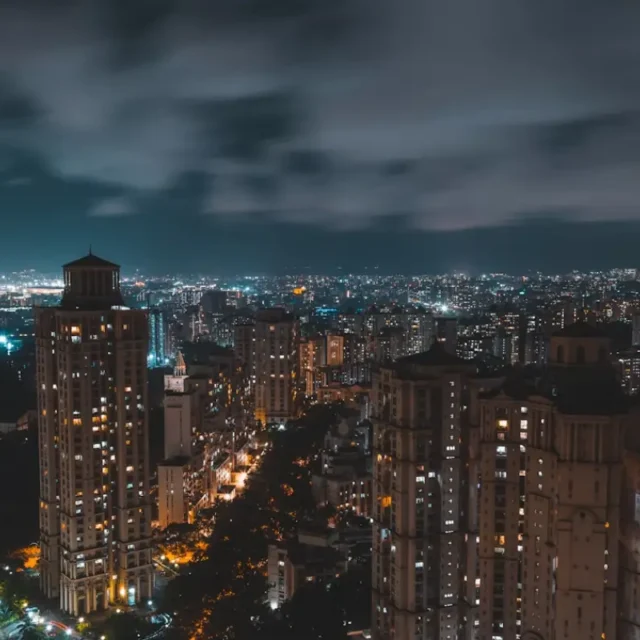
After dark, the curve of streetlights along the bay sparkles like a string of pearls, earning Marine Drive its nickname, the Queen’s Necklace. The view is best from Malabar Hill or the higher floors of the buildings at either end.
What it’s like to visit
Marine Drive is where Mumbai comes to breathe. In the early morning, joggers and walkers fill the promenade; in the evening, especially at sunset, thousands of people of every age sit on the long concrete sea wall, eat roasted corn and peanuts, chat and watch the sun sink into the Arabian Sea. In the monsoon, huge waves crash over the wall, a dramatic sight (keep your distance). It’s free, open at all hours and one of the best ways to feel the city’s energy.
Chowpatty Beach
At the northern end, Girgaon Chowpatty is a broad sandy beach famous for its food stalls, selling Mumbai favourites such as bhel puri (puffed rice with chutneys), pani puri, pav bhaji (spiced vegetable mash with buttered bread) and kulfi. Swimming isn’t recommended. During the Ganesh Chaturthi festival, enormous crowds gather here for the immersion of Ganesh idols in the sea.
Plan your visit
Come for sunset at the end of a day in South Mumbai, after the Gateway of India, the CSMVS museum and CSMT station. Then walk to Chowpatty for dinner on the beach.