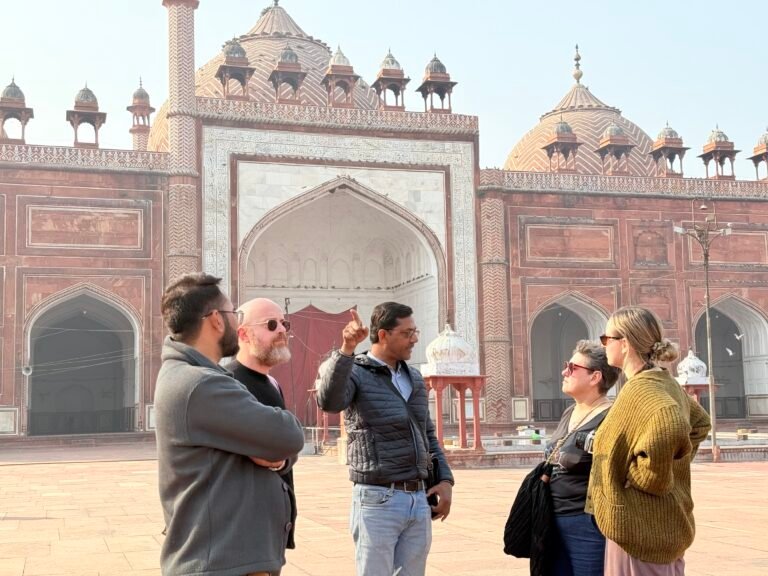
Mathura, on the Yamuna about an hour north-west of Agra, is one of the seven holiest cities of Hinduism, and Shri Krishna Janmabhoomi, “the birthplace of Krishna”, is its most important site. According to tradition, Krishna was born here more than 5,000 years ago in the prison cell where his parents, Vasudeva and Devaki, had been locked up by the tyrant King Kansa. That night, Vasudeva carried the newborn across the flooded Yamuna to safety in Gokul, beginning the stories of Krishna’s childhood in the Braj region.
The temple complex
Temples have stood on this site for many centuries, and the complex today includes:
- Garbha Griha: the sacred shrine marking the prison cell of Krishna’s birth, a small, simple chamber where pilgrims pray.
- Keshav Dev Temple: a temple to Krishna in the complex.
- Bhagavata Bhavan: a large, colourful temple with shrines to Radha and Krishna, Jagannath, Rama and others, and walls inscribed with the Bhagavad Gita.
What it’s like to visit
Security is very strict. Phones, cameras, bags, pens, electronic items and even some food items are not allowed inside and must be left in lockers or cloakrooms outside. After the checks, you follow the flow of pilgrims through the shrines, with chanting, bells and devotional music. It’s crowded, especially on weekends and festivals, and the atmosphere is intensely devotional. Allow about 1–1.5 hours.
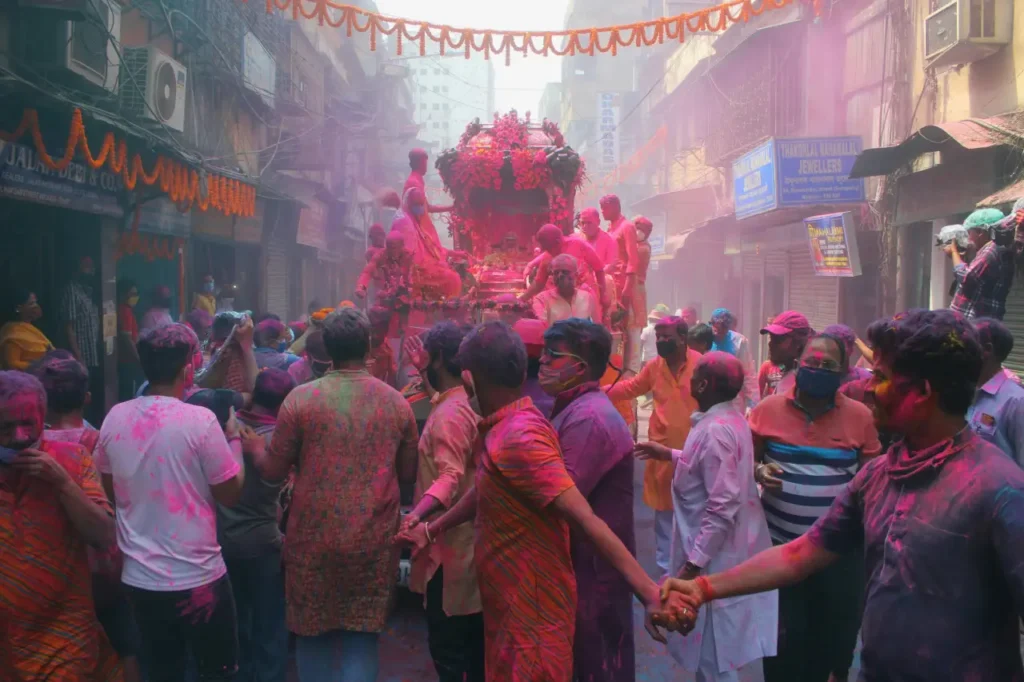
The biggest celebration of the year is Janmashtami, Krishna’s birthday, in August or September, when the temple is decorated and celebrations peak at midnight, the hour of his birth, with enormous crowds.
Tips
- Leave your phone and bag in the vehicle or locker before you queue.
- Dress modestly and remove your shoes where required.
- The temple closes in the afternoon; check timings.
Plan your visit
Mathura is usually combined with nearby Vrindavan, 15 km away, on a day trip from Agra or Delhi. During Holi, the Braj villages of Barsana and Nandgaon host the famous Lathmar Holi. See our Holi festival page.