Krishna’s town
Vrindavan, about 15 km north of Mathura, is where Krishna is believed to have spent his childhood and youth, herding cows, playing his flute and dancing with Radha and the gopis (milkmaids). It’s a town of thousands of temples, filled with pilgrims and chants of “Radhe Radhe” from dawn to night, and Banke Bihari is the temple closest to its heart.
History
According to tradition, the image of Banke Bihari (“the one bent in three places”, in Krishna’s classic flute-playing pose) was revealed in the 16th century to the saint and musician Swami Haridas at the nearby grove of Nidhivan. The present temple, in Rajasthani style, was built in 1864.
A unique darshan
Banke Bihari is unlike most temples. There are no bells or conch shells, because Krishna is worshipped here as a child who shouldn’t be disturbed. Instead of a continuous view, a curtain in front of the deity is drawn closed and opened again every few minutes, a tradition said to stop devotees from being overwhelmed by his gaze. Pilgrims surge forward each time the curtain opens, calling out with joy. The morning aarti is held only once a year, on Janmashtami.
Holi at Banke Bihari
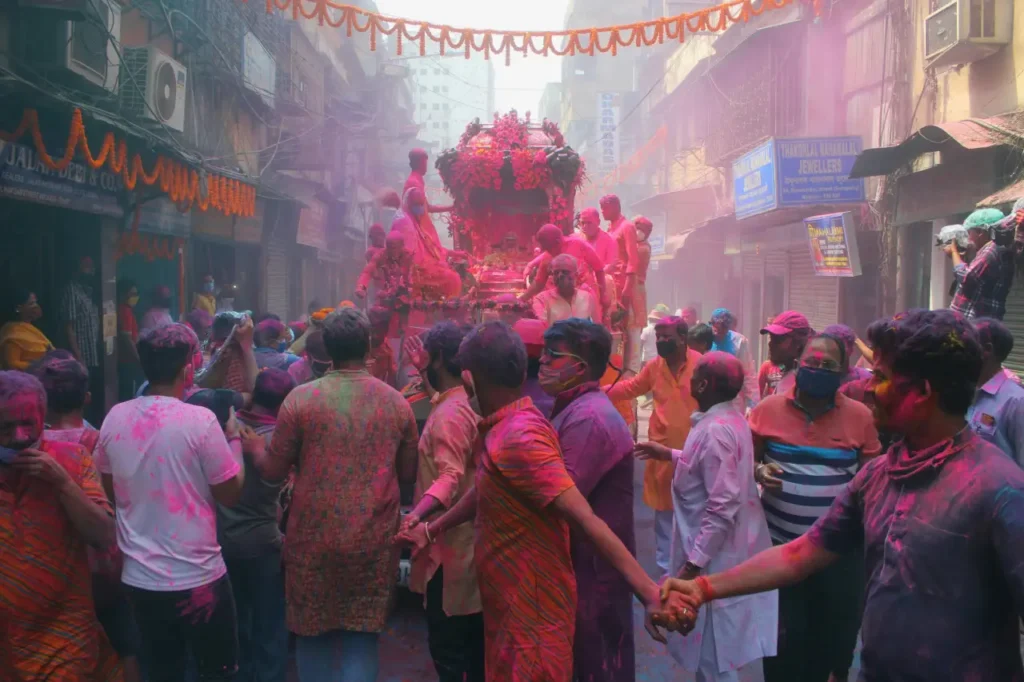
In the days before Holi, the temple celebrates with colour, music and, on Rangbhari Ekadashi, phoolon wali Holi, when priests shower worshippers with flower petals. It’s one of the most joyful and crowded festivals in India.
What it’s like to visit
Expect dense crowds, especially on weekends and festivals; hold on to your belongings, as phones and bags can be snatched in the crush. Monkeys around Vrindavan are known for grabbing glasses and phones. Allow an hour, more with queues.
Also in Vrindavan
- ISKCON Krishna Balaram Mandir (1975): calm, with a lively evening aarti and kirtan.
- Prem Mandir (2012): a white marble temple lit up with colourful lights and music in the evening.
Plan your visit
Combine Vrindavan with Krishna Janmabhoomi in Mathura on a day trip from Agra or Delhi. See our Holi festival page.