
Over 8 million tourists visit the Taj Mahal every year and if you are planning a taj mahal tour too, this is the only taj mahal guide you need to look to. The Taj Mahal is a famous landmark in India, a UNESCO World Heritage Site and a wonder of the world. The monument is over 400 years old and allures the mind and soul of every visitor that sees it. The architectural marvel has a deep history and story of love that led to the construction of this magnificent monument.
Let us know in deeper sense
Introduction to the Taj Mahal: A Masterpiece of Love, Architecture, and Legends
The Taj Mahal is instantly recognizable worldwide, yet its true history is as intricate and captivating as its glowing marble facades. Conceived as a “masterpiece for ages to come,” the mausoleum was designed not just as a memorial for a beloved queen, but as an earthly replica of her heavenly mansion in Paradise, and a lasting testimony to the glory of Mughal rule.
Here is a deep dive into the epic romance, unparalleled architectural brilliance, and the fascinating myths surrounding India’s most famous monument.
The Epic Love Story of Shah Jahan and Mumtaz Mahal
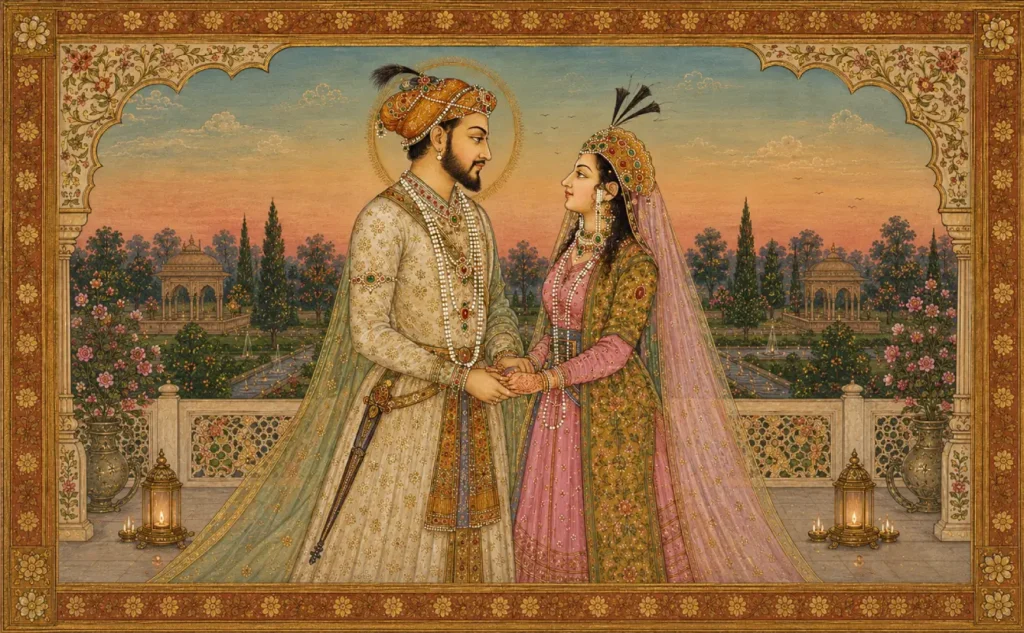
The story begins with the young Prince Khurram (later Emperor Shah Jahan) and Arjumand Banu Begam, who was bestowed the title Mumtaz Mahal, meaning “Chosen One of the Palace”. Their relationship was extraordinary for its time. Contemporary sources reveal a deep affection, intense intimacy, and an open erotic attraction between the royal spouses that was entirely unheard of in the 17th-century Muslim world. For nineteen years, Mumtaz Mahal was the emperor’s close confidante and had no rival in his heart, bearing him fourteen children.
A Devastating Tragedy
Tragedy struck in June 1631 in Burhanpur, where the court was stationed during a military campaign. Shortly after giving birth to her fourteenth child, Gauharara Begam, Mumtaz Mahal’s condition rapidly deteriorated, and she died at the young age of thirty-eight. She was temporarily buried in the Zainabad garden across the Tapti river before her body was escorted back to Agra in December 1631.
Shah Jahan’s Profound Grief
The emperor was utterly shattered by his wife’s death. Breaking all strict court protocols, he wept uncontrollably and wore white garments—the Indian colour of mourning. He did not appear in public for an entire week and even contemplated abdicating his throne to live as a religious recluse. For two full years, Shah Jahan abandoned music, perfumes, jewellery, and colourful clothes, and his heartbreak was so severe that his hair and beard turned grey and white.
The Grand Construction: Construction of the Taj Mahal
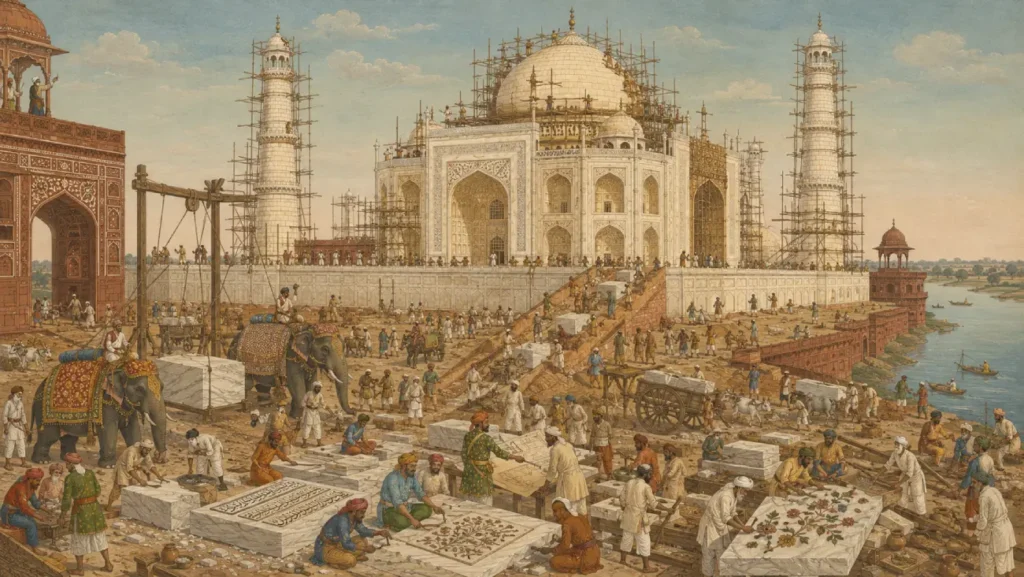
The Taj Mahal was commissioned in 1632 by Mughal Emperor Shah Jahan in memory of his beloved wife Mumtaz Mahal, who passed away during childbirth. Heartbroken by her death, Shah Jahan envisioned a monument so magnificent that it would symbolize eternal love for centuries to come. To build the ultimate resting place, Shah Jahan acquired a prime riverfront site from Raja Jai Singh of Amber, giving him four other mansions in exchange to ensure the land was legally and properly obtained.
Construction of the Taj Mahal took approximately 22 years and involved more than 20,000 artisans, laborers, stone cutters, calligraphers, dome specialists, and craftsmen from across India, Persia, and Central Asia.
At a time when there were no cranes, no modern machinery, and no advanced engineering software, the Mughal builders created one of the most mathematically precise and symmetrical structures in human history.
Architectural Significance and Dazzling Details
The Taj Mahal complex is the pinnacle of Shahjahani architecture, characterized by strict geometry, perfect bilateral symmetry (qarina), and a hierarchical grading of forms.
Key Dimensions:
- Height of the main mausoleum: approximately 73 meters (240 feet)
- Height of each minaret: around 40 meters (130 feet)
- Entire complex area: nearly 42 acres
- Central dome height: about 35 meters
Size & Scale: The layout was meticulously planned on a modular grid system using the Mughal yard (gaz), with the overall complex spanning a width of 374 gaz.
Colour Hierarchy: The Mughals used a highly symbolic colour dualism. The central mausoleum is clad entirely in highly polished white marble to symbolize absolute purity and spiritual rank, while the subsidiary structures (the gates, mosque, and assembly hall) are built of red sandstone, reflecting traditional Indian concepts linking white to priestly purity and red to warrior power.
The Leaning Pillars The four minarets surrounding the Taj Mahal slightly lean outward as a protective structural feature. This subtle inclination is almost invisible to the naked eye but represents one of the earliest examples of earthquake-conscious architecture in India.
Translucent White Marble One of the most unique features of the Taj Mahal is the translucent quality of its marble. During sunrise and sunset, sunlight penetrates the upper surface of the marble, causing the monument to glow softly from within. This gives the Taj Mahal its almost dreamlike appearance.
Pietra Dura Inlay: The architecture famously utilizes the pietra dura technique (known to Mughals as parchin kari), where semi-precious stones like lapis lazuli, jasper, carnelian, and agate are intricately sawn and inlaid into the marble to create breathtakingly realistic floral bouquets and arabesques.
The Charbagh Gardens: Paradise on Earth
The central garden, named bagh-i firdaus-a’in (Paradise-like garden), was designed as a literal replica of the Qur’anic gardens of Paradise. It features cross-axial paved walkways that divide the space, complete with shallow canals and fountains. To ensure the paradisiacal bloom was permanent, the garden’s living fruit trees and fragrant cypresses were conceptually extended into the eternal, unfading stone flowers carved into the mausoleum’s walls.
Busting the Myths
The Taj Mahal’s unparalleled beauty has birthed several enduring legends:
- The Black Taj Mahal: A famous story, first recorded by Tavernier in 1665, claims Shah Jahan intended to build a replica of the Taj in black marble for himself across the river, but was stopped by his son Aurangzeb. Excavations in the 1990s at the Mahtab Bagh site proved this false, revealing no such foundations.
- The Mutilated Workers: Tourist guides often recount a gruesome tale that Shah Jahan ordered the hands of the architects and craftsmen to be chopped off so they could never recreate such beauty. This is pure fiction. It actually belongs to a well-known group of global folklore motifs where kings mutilate the creators of great monuments to preserve their uniqueness.
Taj Mahal is a UNESCO World Heritage Site
The Taj Mahal was granted the status of a UNESCO World Heritage Site in 1983. Since then, the number of people visiting the monument increased significantly. Since granting the status, it quickly became one of the most visited landmarks in india. State heads of over a 100 countries have visited this iconic monument that still stands tall in the memory of lovers.
Visiting the Taj Mahal
Taj Mahal Monument Tickets with Prices
Visitors generally purchase tickets in two categories:
- General Entry Ticket: ₹50
- Main Mausoleum Access Ticket: ₹200 additional on General Entry Ticket
The mausoleum ticket allows entry inside the central tomb chamber.
International vs Indian Tourist Tickets
Ticket prices differ for:
- Indian citizens: ₹50 + ₹200 (Main Mausoleum)
- Foreign nationals/NRI: ₹1100 + ₹200 (Main Mausoleum)
- SAARC/BIMSTEC visitors: ₹540 + ₹200 (Main Mausoleum)
Opening and Closing Timings
The Taj Mahal is generally open:
Daytime Viewing: 30 mins before the sunrise till 30 minutes before the sunset. Usually 5:30 AM to 6:00 PM. Check with your travel agency for exact timings.
Night time Viewing: Taj Mahal night time viewing depends upon full moon dates. You can check with your travel agency or Check with the Taj Mahal Government website for exact dates.
Friday Schedule
The monument remains closed on Fridays for regular tourists because prayers are conducted at the mosque inside the complex.
Best Time to Visit the Taj Mahal
Sunrise Visit
The sunrise is the best time to visit and experience the beauty of the Taj Mahal. The pristine white marble of the Taj Mahal is translucent in nature. It passes the light within it and causes a glowing effect. This effect is only possible during the sunrise. Hence, a lot of visitors reach the Taj Mahal complex around 5:30am to get the first glance of the monument during the sunrise and see the monument changing color.
Another reason why tourists prefer the early sunrise for Taj Mahal sightseeing is the cooler temperatures. Agra remains a hot climate city for most of the year. Hence, dawn time is cooler compared with day time. This time also offers perfect soft golden light ideal for photography. Sunrise at the Taj Mahal feels peaceful and deeply emotional.
Sunset Visit
Sunset creates a completely different mood. The marble begins turning golden and warm as the sun descends. The atmosphere becomes romantic, dramatic, and visually stunning.
Sunset is excellent for:
- Silhouette photography
- River-view photography
- Slow exploration
Best Months to Visit
The ideal months are:
- November – Pleasant weather
- December – Pleasant and cold weather
- January – Cold weather
- February – Pleasant and cold weather
- March – Pleasant weather
These months offer:
- Pleasant weather
- Clearer skies
- Better photography conditions
- Comfortable walking temperatures
Avoid peak summer afternoons between April and June, as temperatures in Agra can become extremely high
How to Visit the Taj Mahal
By Road
Agra is well connected by modern expressways including the Yamuna Expressway from New Delhi.
Travel Time:
- Delhi to Agra: approximately 3–4 hours
Private taxis and luxury cars are common choices for tourists. When you book your Taj Mahal tour with a Government Registered Travel agency, you get an all inclusive tour that includes your airport pickup, drop, and meals.
By Train
Trains are another way to experience the beauty of Taj Mahal. You can reach Agra via Train from all major Indian cities including Delhi. The most prominent railway stations in Agra are –
- Agra Cantt
- Agra Fort
Taj Mahal tour by Train offers –
- Country-side views
- Indian Railways Journey
Taj Mahal Tour Options
Private Guided Tour
Private Guided tours are the most sought after tours for foreign tourists in India. These typically include everything right from your pickup, monument tickets, sightseeing experience, meals and drop off. A Government-certified tour guide accompanies you to the monuments, explaining to you well about the history, heritage of the monument. A tour guide sets up your day for an experience that you won’t get otherwise.
Ideal for:
- Families
- Luxury travelers
- Photographers
- First-time visitors
Benefits:
- Safe and Secured
- Personalized storytelling
- Flexible timing
- Historical explanations
- Better photography assistance
Group Tours
Group Tours are another way to explore the Taj Mahal. You get all the features of a Private tour, but for a group. Group tours are suitable for:
- Budget travelers
- Backpackers
- Social travelers
These tours are generally more affordable and follow fixed schedules.
Women-Only Tours
Women-only travelers are on a rise in India. If you are a woman and traveling either solo or with friends or group, these tours will suit you the best. Our women-only tours offer –
- Safe and secured sightseeing experience
- Female tour guides
- Cultural comfort
- Easy pickup and drop offs
Walking Tours
The area near the Taj Mahal poses significant historical and cultural value. The Taj Ganj was established during the Mughal era and today is an important area for walking tours. You tend to explore
- Mughal-era Art forms
- Hidden viewpoints
- Local cuisine
- Unique Photography spots
These experiences often feel more authentic than rushed sightseeing tours.
Scams to Avoid on a Taj Mahal Tour
Shopping Scams
Pushy shopping scams are common in Agra. People claiming to sell Original Mughal Artifacts, Government-certified Marble souvenirs and rare gemstones can be misleading and expensive. Seek assistance from your tour guide or travel agency if you want to purchase authentic souvenirs. Never agree to pushy sales tactics.
Fake Guide Scams
It has been ascertained at multiple times that fake tour guides host the travelers and indulge them in scams, and aggressive sales. Beware of such people. Always hire Government-certified tour guides and verify them before the start of the tour. It is advisable to book your Taj Mahal tour through Government-Registered Travel Agencies only.
Common Mistakes to Avoid at the Taj Mahal
Carrying Restricted Items
- Food items are generally not allowed inside the complex.
- Large bags and unnecessary electronics should also be avoided.
- Bringing Tripods
- Tripods are prohibited without special permission.
- Professional photographers may require separate approvals.
- Using Drones or Aerial Photography
- Aerial photography and drone usage are strictly prohibited around the Taj Mahal due to security regulations.
Final Thoughts
The Taj Mahal is not merely a monument built in marble.
It is a masterpiece of engineering, poetry carved in stone, and a timeless reminder of how art and emotion can transcend centuries.
Built with extraordinary precision by over 20,000 workers, decorated with rare gemstones from across the world, and designed with breathtaking symmetry, the Taj Mahal continues to stand as one of humanity’s greatest achievements.
Whether you visit at sunrise, wrapped in soft morning mist, or during sunset under golden skies, the Taj Mahal leaves an impression that stays with you forever.